📜 What This Guide Covers
Deva Prasnam — When the Temple Speaks
ദൈവം മൗനത്തിൽ മൊഴിയുന്നത്, ജ്യോതിഷം ഭാഷയാക്കുന്നത്
In Kerala's living temple tradition, a Deva Prasnam (also written Devaprasnam or Deivaprasnam) is a solemn, multi-day ritual inquiry — conducted by expert Vedic astrologers called Prasna Vidwans — into the spiritual state of a temple deity, the integrity of the consecrated idol, the sanctity of the temple grounds, and the well-being of the surrounding community.
The practice reflects a core belief of Kerala's temple theology: that a consecrated deity is a living presence whose energy can be affected by human actions, natural events and the ritual integrity of daily worship. Deva Prasnam is understood as the mechanism by which the temple community discerns what the deity needs.
This guide explains the tradition in depth — and, because some retellings of "famous Devaprasnam cases" circulate online with very specific-sounding findings that we couldn't trace to any real source, we've been careful here to separate what's genuinely documented from what's a general pattern associated with a type of temple.
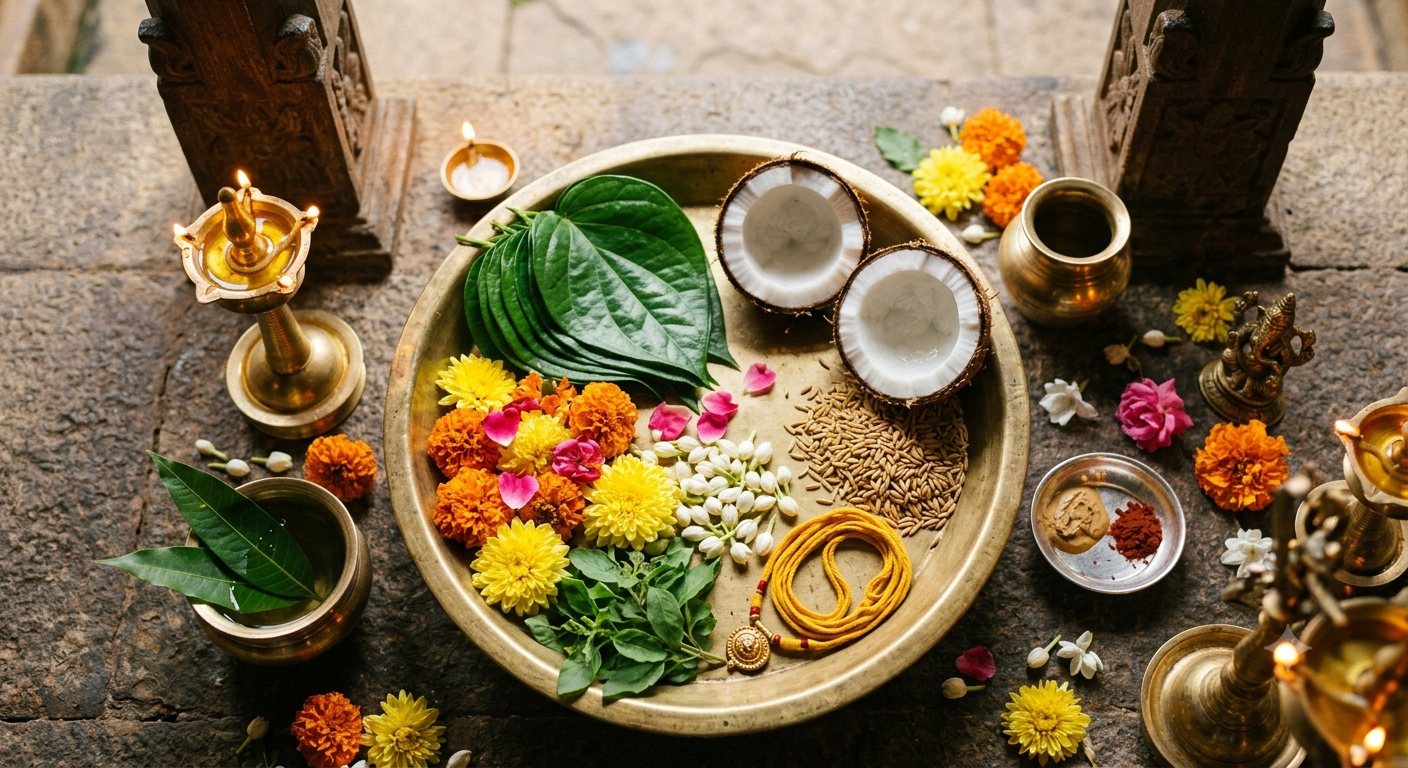
What Is Deva Prasnam? — The Sacred Astrological Inquiry Explained
ദേവ പ്രശ്നം — ജ്യോതിഷ അന്വേഷണം
A Deva Prasnam is a specialised form of Kerala's Prasna Shastra — the science of astrological inquiry — applied specifically to the state of a consecrated deity. While ordinary Prasna Jyotisha answers questions about individual human life events, Deva Prasnam applies this same astrological framework to the temple as a whole.
The ritual rests on the tantric understanding that a deity's energy field, established through the original Prana Pratishta (consecration), can be affected over time by damage to the idol, lapses in daily ritual, construction errors, natural events, pollution of sacred groves or water bodies, or simply the passage of time. Deva Prasnam is the traditional tool for identifying these and prescribing remedies.
Who Conducts Deva Prasnam?
A Deva Prasnam is conducted by one or more Prasna Vidwans — astrologers trained in Kerala's Prasna Jyotisha tradition, particularly as codified in the classical text Prasna Marga. The most respected Prasna Vidwans belong to specific lineages that have preserved this knowledge across generations. The temple's tantri (hereditary chief priest) and senior temple administrators are typically also involved.
Prasna Marga ("The Path of Questions") is composed in Malayalam-Sanskrit verse and is generally dated to the 17th century. It remains the foundational reference work for Prasna Jyotisha in Kerala, including Deva Prasnam, with English translations and commentaries available for interested readers.
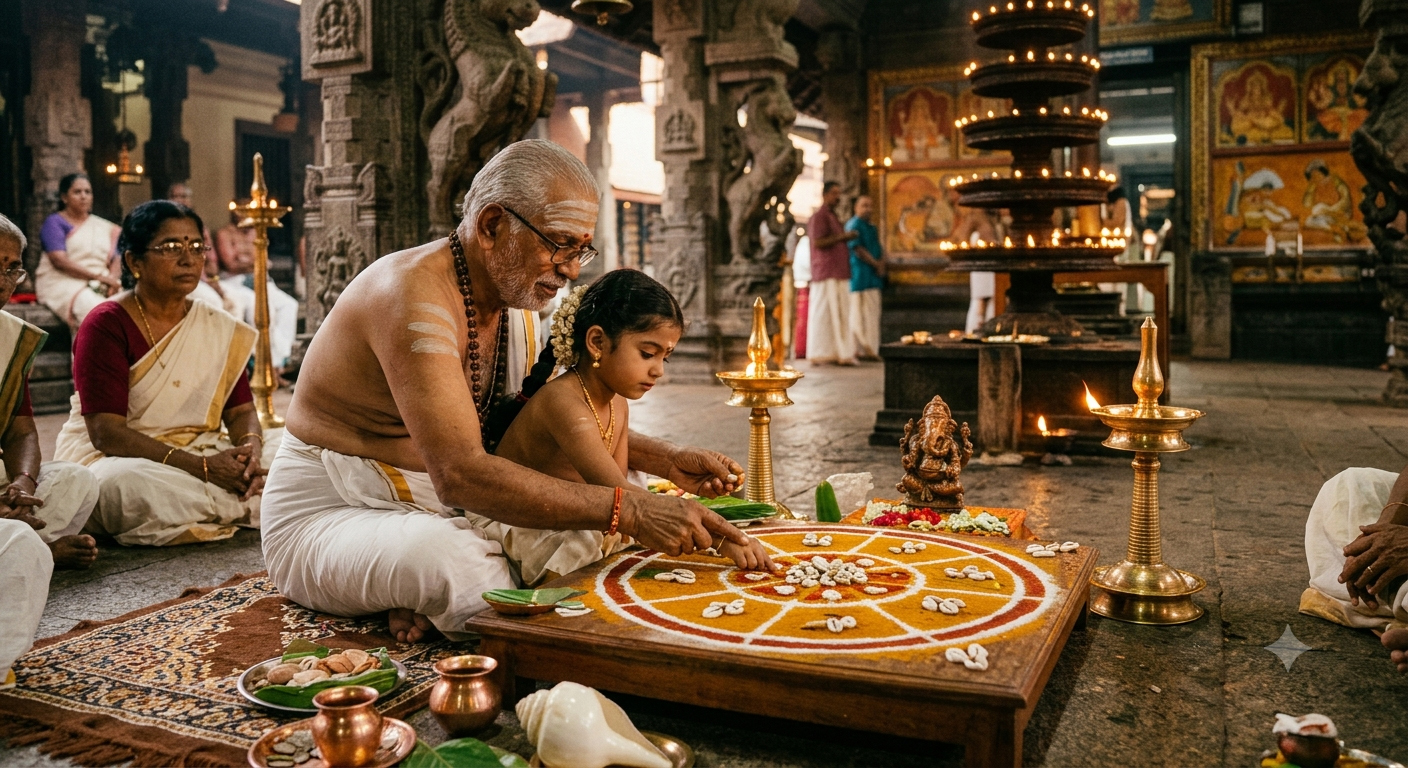
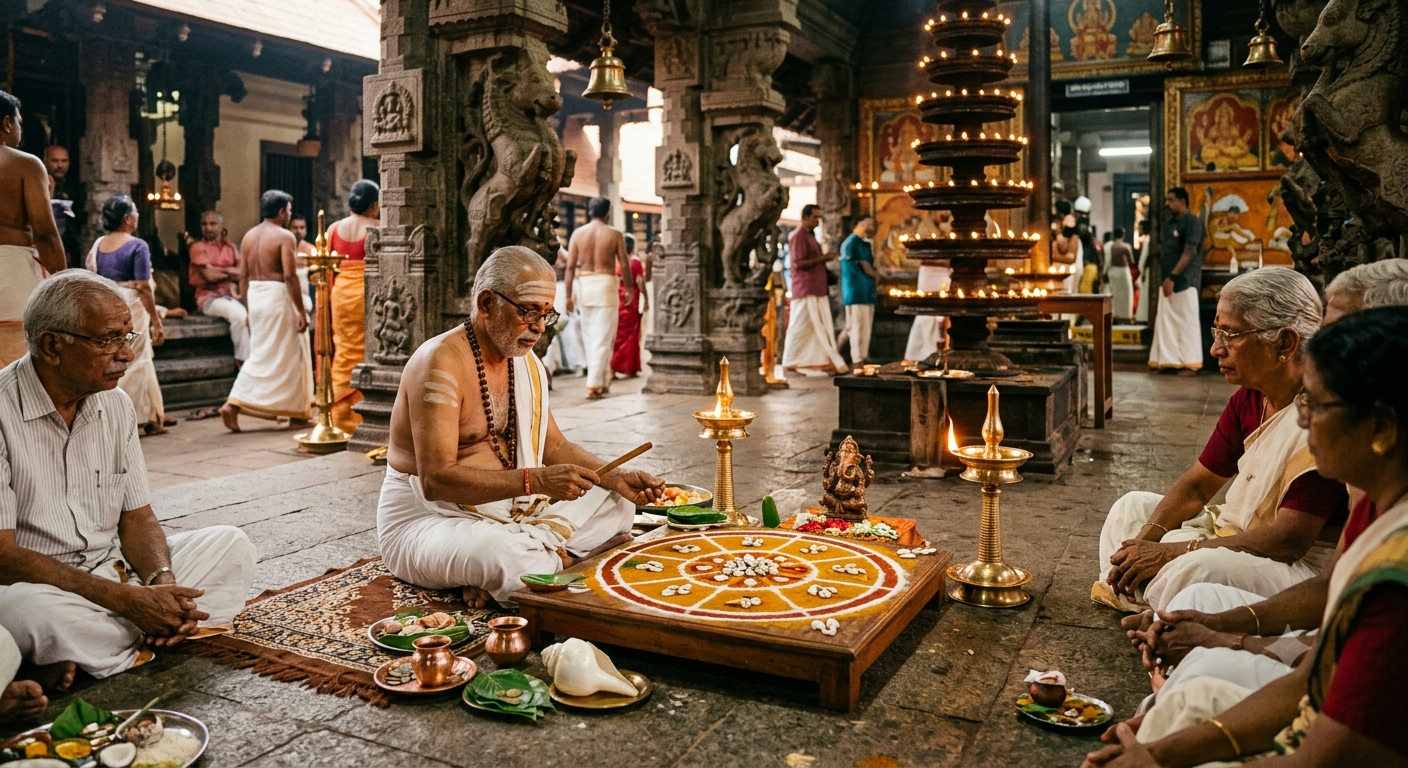
How Deva Prasnam Is Conducted — The Ritual Procedure
ദേവ പ്രശ്ന ക്രമം
A Deva Prasnam combines Vedic astrological calculation, cowrie shell divination (kavadi), the construction of a Prasna chart for the exact moment of inquiry, and consultation with the temple's tantri. The process typically unfolds over one to several days.
The Deva Prasnam Procedure, Step by Step
- Selection of the auspicious moment (muhurta): the Prasna Vidwan, with the tantri and temple administration, identifies an astrologically auspicious date and exact time to begin — this moment anchors the Prasna chart.
- Preparation of the sacred space: the inquiry area is ritually purified with panchagavya and flowers, and a sacred yantra is drawn on the floor or a copper plate.
- Pooja and invocation: pujas are performed to the deity, to Ganesha, and to the navagrahas (planets) to sanctify the inquiry.
- A child's selection of Rasi: a distinctive feature of Deva Prasnam is the participation of a young, ritually prepared child, who is asked to point to a zodiac sign or pick up a cowrie shell without prior knowledge. Within the tradition, a child's selection is considered free of adult deliberate intent, and so a more transparent channel for what the inquiry reveals.
- Construction of the Prasna chart: the astrologer builds a detailed chart (Prasna Kundali) for the exact moment of the child's selection, interpreted using Parasara and Kerala Jyotisha methods alongside Prasna Marga.
- Cowrie shell divination (kavadi prayoga): cowrie shells are thrown and their resulting pattern interpreted against specific astrological houses.
- Analysis and consultation: over one or several days, a team of Prasna Vidwans (often three to seven for major temples) analyse the chart and cowrie patterns alongside the temple's ritual history and the idol's condition.
- Public declaration of findings: the Vidwans declare their findings and prescribe specific remedies (parishkarams) — which may include particular pujas, idol renovation or re-consecration, or changes to the temple's ritual schedule.
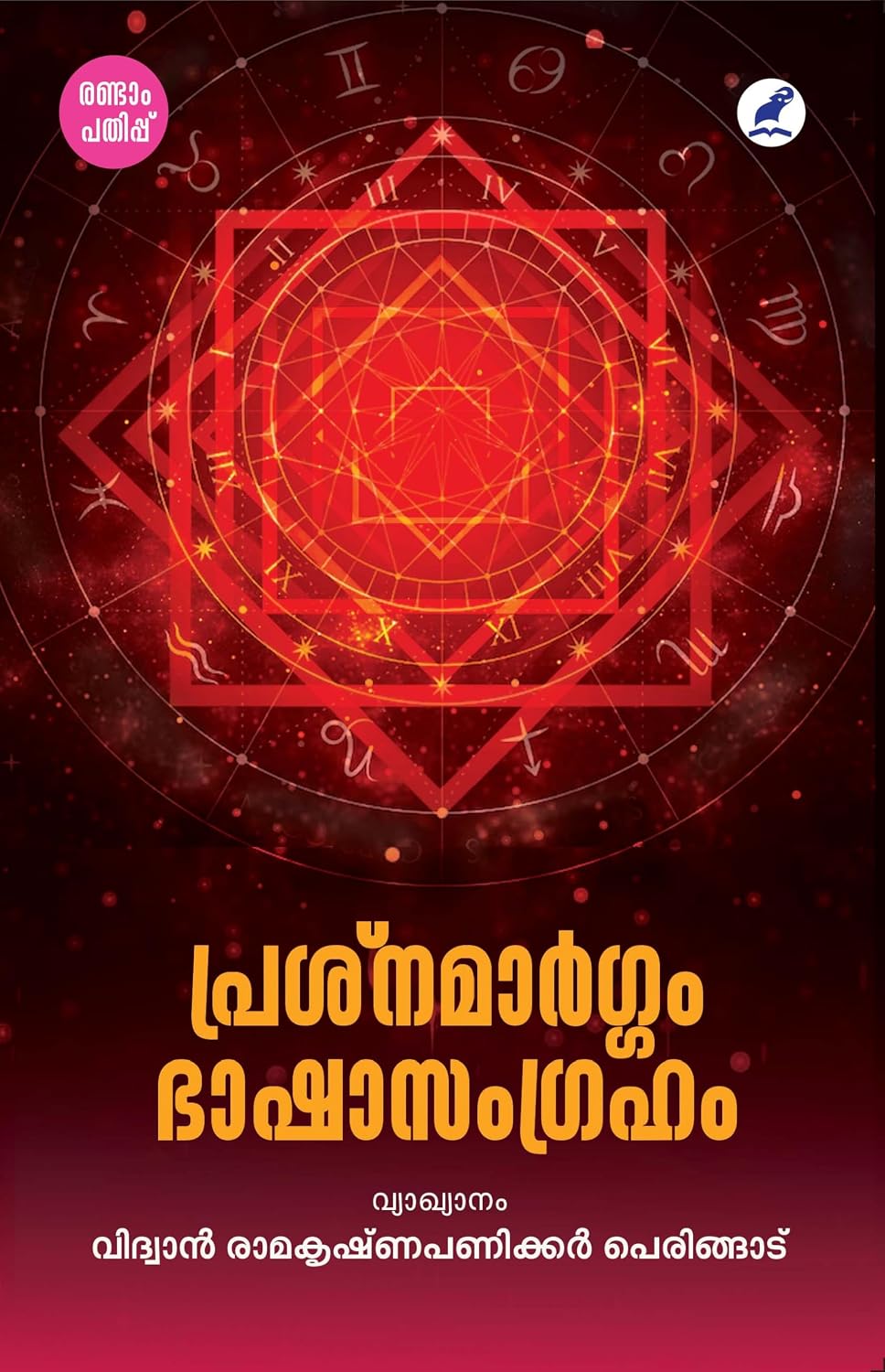
Prasna Margam Bhasha Samgraham — The Classical Kerala Astrology Text
The foundational reference for Kerala's Prasna Jyotisha tradition — the classical text underpinning every Deva Prasnam conducted in Kerala temples.
View on Amazon →Affiliate link — we earn a small commission at no extra cost to you. See our Affiliate Disclosure.
Historical Background of Deva Prasnam in Kerala
ചരിത്ര പശ്ചാത്തലം
Deva Prasnam draws on several streams of classical Kerala knowledge:
- Prasna Shastra — the science of astrological inquiry, applied here to the welfare of consecrated deities and sacred spaces. Kerala's Prasna Jyotisha tradition is widely regarded as among the most elaborately documented in India.
- Tantra Shastra — the tantric understanding that a consecrated idol is a living energy field, capable of disturbance and restoration, provides the theological basis for the practice.
- Kerala's Devaswom Boards — the Travancore, Malabar and Cochin Devaswom Boards, which manage most of Kerala's major temples, have formalised Deva Prasnam as a recognised institutional practice, commissioning and funding these inquiries at temples under their management.
Historically, Deva Prasnam was conducted after specific events — a fire, structural damage, reports of unusual occurrences, or a sense among the tantri that daily worship had lapsed in quality. Many temples have also adopted periodic cycles, commonly cited as every 5, 11 or 27 years, as a preventive check. Individual cycle lengths vary by temple tradition and administrative decision, and specific schedules should be confirmed with the relevant Devaswom Board rather than assumed to be universal.
Deva Prasnam findings at major temples have periodically drawn wide media coverage in Kerala, especially where they touch on temple governance, ritual disputes or environmental concerns.
A traditional framing
"ദേവ പ്രശ്നം — ദൈവം മൗനത്തിൽ മൊഴിയുന്നത്, ജ്യോതിഷം ഭാഷയാക്കുന്നത്."
Deva Prasnam — what the deity speaks in silence, astrology translates into words. The inquiry doesn't ask whether the deity is present; that's taken as given. It asks whether the conditions for the deity's gracious presence are being maintained by the human community.
Documented Cases & Temple Patterns
രേഖപ്പെടുത്തിയ കേസുകളും ക്ഷേത്ര മാതൃകകളും
A number of Deva Prasnam cases at Kerala's major temples have been widely reported in the Malayalam press over the decades. Below, we've separated the cases we could verify with real, traceable reporting from the general pattern of concerns that Deva Prasnam characteristically raises at different types of temples — rather than presenting invented specifics as documented history.
Guruvayur Sri Krishna Temple — The 2007 Ashtamangala Devaprasnam
What's genuinely documented
An eight-day Ashtamangala Devaprasnam at Guruvayur, reported at the time in Malayalam and diaspora Hindu press, addressed a range of temple matters. Among the findings reported: a review of a recent relaxation to the temple's dress code (which had permitted women devotees to wear churidar, a change the inquiry reportedly found the deity's tradition did not support); a "Sukrutha Homam" prescribed to be performed annually with a substantial number of Gayatri Mantra recitations to increase the temple's spiritual merit; the tantri's own atonement (prayaschittham) for ritual lapses; and, following a finding sometimes referred to as "Go-sapa" (a curse connected to cows), an offering of a golden image of a cow to the goddess, after a live cow was judged insufficient as an offering. Objections were also reportedly raised by some Devaswom managing committee members during the proceedings.
Guruvayur has separately been the subject of state government financial audits in more recent years — covering issues like undocumented ivory and irregular asset verification — but those audits are a distinct administrative matter, not a Deva Prasnam finding, and shouldn't be conflated with the temple's ritual inquiries.
Sree Padmanabhaswamy Temple — The 2011 Vault B Devaprasnam
What's genuinely documented
This is the most widely reported Deva Prasnam in Kerala's recent history. In 2011, shortly after a Supreme Court-ordered inventory revealed enormous wealth in five of the temple's six vaults, a four-day Devaprasnam was conducted at the temple. According to contemporary media reports, the astrologers concluded that the temple's still-sealed Vault B should not be opened under any circumstances, warning of serious consequences for anyone who did so, and identified the vault's location as spiritually significant. The same inquiry reportedly also surfaced findings about financial irregularities in the temple's administration and lapses in some traditional daily poojas.
This recommendation became directly relevant to the Supreme Court proceedings over the temple's vaults, with the Travancore royal family and the temple's tantri repeatedly citing it, along with the belief that the vault carries a protective serpent (naga) symbol, as reasons the vault has remained closed to the present day.
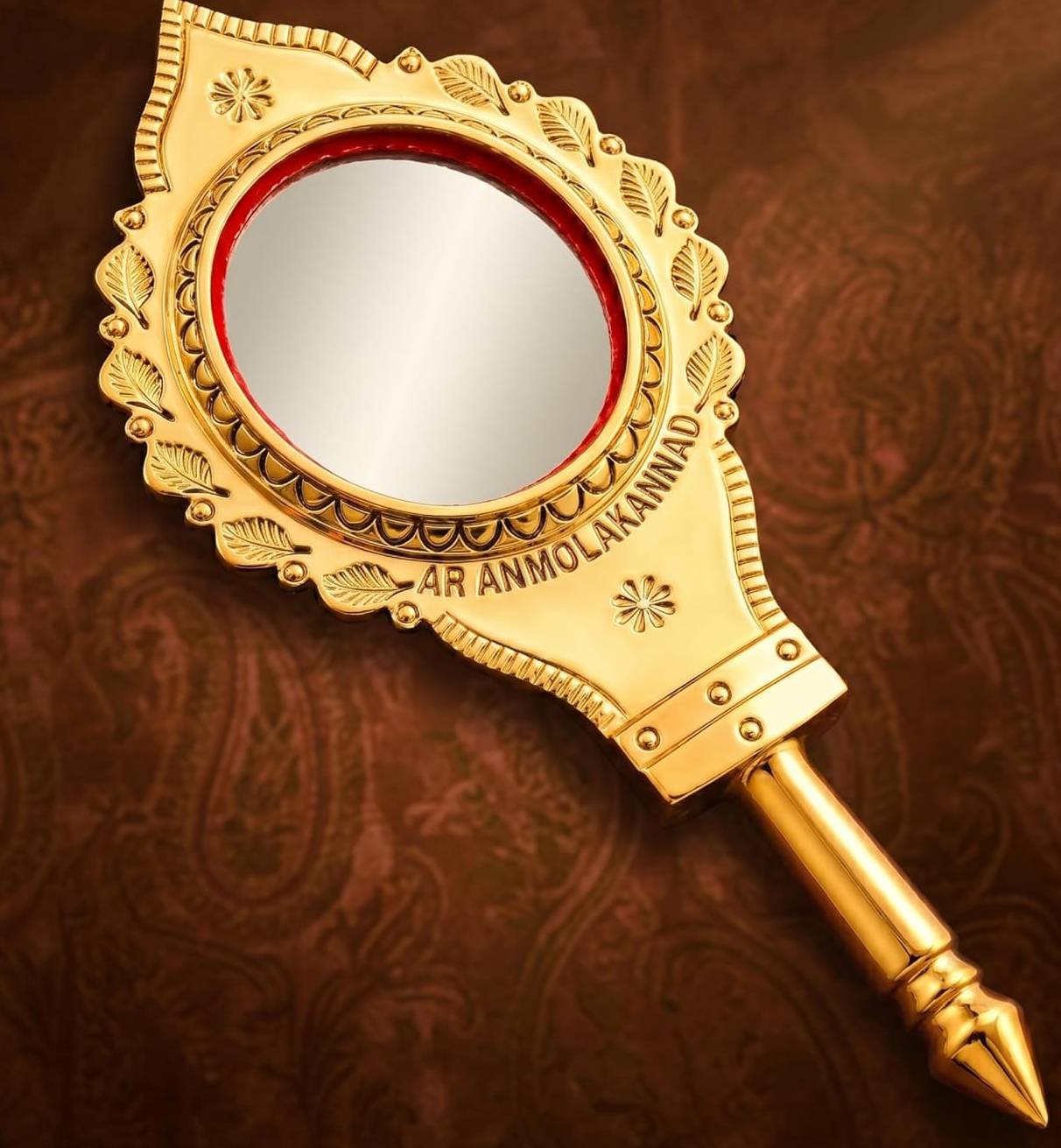
Aranmula Kannadi — Sacred Metal Mirror of Kerala
GI-tagged sacred metal mirror handcrafted near the Parthasarathy Temple at Aranmula — among Kerala's most auspicious heirlooms, traditionally given as sacred gifts.
View on Amazon →Affiliate link — we earn a small commission at no extra cost to you. See our Affiliate Disclosure.
Sabarimala Sree Dharma Sastha Temple — The 1950 Desecration and Reconsecration
What's genuinely documented
Sabarimala's best-documented instance of a major ritual response to crisis followed the events of 1950, when the original sanctum was found burnt and the idol of Ayyappa deliberately broken — a case investigated at the time as arson rather than an accidental fire, though the perpetrators were never conclusively identified. The temple was subsequently rebuilt and the deity reconsecrated. We can't verify the specific step-by-step details of any astrological inquiry conducted as part of that restoration, so we're not asserting a detailed "Deva Prasnam finding" here — but the episode is real, well documented in Kerala's historical record, and illustrates why temples of Sabarimala's kind, deep within protected forest, treat the physical and ecological integrity of the site as inseparable from the deity's own wellbeing.
More recently, Sabarimala's forest setting inside the Periyar Tiger Reserve has continued to raise real, reported concerns — including unauthorised entry into the restricted forest area near Ponnambalamedu, where the Makaravilakku flame is lit — that reflect the same underlying concern with protecting the sanctity of the surrounding forest.
The temples below: general pattern, not specific documented findings
For the following temples, we don't have verified sourcing for specific Deva Prasnam findings tied to a dated event. Rather than present invented specifics as fact, we describe the kind of concerns Deva Prasnam characteristically raises at a temple of this type — which is genuine and informative, but should be read as a pattern, not a documented case history.
Kodungallur Sree Kurumba Bhagavathi Temple — The Pattern at Ancient Devi Shrines
Kodungallur is among the oldest and most powerful Devi temples in Kerala, known for the deity's fierce (ugra) temperament and the transgressive Kodungallur Bharani festival. At ancient Shakteya temples of this kind, Deva Prasnam inquiries are generally understood, within the tradition, to focus on the health of the temple's sacred grove (many of which have shrunk due to urbanisation), the preservation of distinctive festival traditions, and community harmony in the surrounding area — themes consistent with the deity's traditional association with land, water and the wider community's wellbeing.
Thrissur Vadakkumnathan Temple — The Pattern at Kerala's Architectural Landmarks
Vadakkumnathan is one of Kerala's oldest and largest Shiva temples, notable for its rare circular (vattappad) sanctum and its role as host of Thrissur Pooram. At architecturally significant temples like this, Deva Prasnam inquiries are generally understood to give particular attention to the physical condition of unusual or ancient structural features, the maintenance of murals and woodwork, and the ritual protocols required when multiple deities are ceremonially assembled during major festivals.
Parassinikadavu Muthappan Temple — The Pattern at Egalitarian Shrines
Muthappan is worshipped without caste or religious restriction, with puja performed by the Thiyya community rather than Brahmin priests, and toddy and fried fish accepted as prasadam. At temples built around this kind of radically inclusive tradition, any ritual inquiry is generally understood to weigh community harmony and inter-community relations heavily, alongside the ecological health of the river or coastal setting the temple depends on — themes that follow naturally from the deity's own character rather than being unique to any single documented event.
Kottiyur Siva Temple — The Pattern at Open-Air Forest Shrines
Kottiyur is unique in Kerala for having no permanent temple building — worship centres on a swayambhu (self-manifested) lingam in an open forest clearing beside the Bavali river, active only during the 27-day Vysakha Mahotsavam. Because the "temple" here is inseparable from the surrounding forest and river, any ritual inquiry at a site like this naturally centres on forest and river health as much as on ritual practice itself — a pattern consistent with how the tradition treats forest deities generally, rather than a specific documented finding we can cite.
Major Recommendations Commonly Made in Deva Prasnam
സാധാരണ പരിഹാര നിർദ്ദേശങ്ങൾ
Across Kerala's many Deva Prasnam cases, certain types of remedy (parishkaram) recur consistently. These reflect the general concerns that Kerala's tantric and astrological tradition associates with a temple's spiritual health.
| Recommendation | Purpose | Typically Prescribed When |
|---|---|---|
| Brahmakalasham | Grand re-consecration to restore the idol's divine energy | Idol shows damage or energy depletion, or after major renovation |
| Punarprathishta | Full re-installation and re-consecration of the idol | Idol is significantly damaged or original consecration energy has greatly diminished |
| Laksha Archana | Recitation of the deity's 100,000 names with flower offerings | General spiritual strengthening; remedying lapses in daily archana |
| Kalashabhishekam | Ritual bathing of the idol with water from 108 or 1008 sacred pots | Restoring the idol's energy after disturbance |
| Navagraha Shanti | Pacification rituals for specific planetary energies | The Prasna chart reveals adverse planetary configurations |
| Sarpa Bali / Nagaprathishta | Rituals appeasing serpent deities; re-establishing serpent shrines | Sacred groves have been disturbed or serpent worship has lapsed |
| Kavu Restoration | Ecological restoration of sacred groves attached to the temple | The kavu has been encroached upon or degraded |
| River / Water Body Puja | Ritual protection and restoration for sacred water sources | The temple's pond, river or water source shows pollution or depletion |
| Ganapathi Homa | Fire ritual to Ganesha, remover of obstacles | A general preliminary remedy when obstacles are indicated |
Deva Prasnam recommendations are issued as religious and astrological guidance. Implementing them is a decision for the temple administration, the tantri, and — for temples under their management — the relevant Devaswom Board. These recommendations operate within Kerala's temple governance laws rather than as legally binding directives, though as the Padmanabhaswamy case shows, they can carry real weight in how a temple's administration and even courts approach a dispute.
Cultural & Religious Significance of Deva Prasnam
സാംസ്കാരിക പ്രാധാന്യം
A Living Interface Between Temple, Community and Nature
Deva Prasnam occupies a distinctive place in Kerala's cultural life because it functions simultaneously as astrological practice, tantric theology, temple governance and, often, ecological concern — all within a single ritual inquiry. At a theological level, it embodies the tantric understanding that a temple is a living system requiring ongoing attention, not a static building.
Ecology and Deva Prasnam
A genuinely notable and widely observed feature of Deva Prasnam in the modern era is how often its findings touch on ecological concerns — degraded sacred groves, polluted temple water bodies, deforestation around forest temples. This reflects a longstanding thread in Kerala's temple tradition that treats the sacred and the ecological as closely bound together, evident even in a well-documented case like Sabarimala's, where the temple's forest setting is inseparable from how its sanctity is understood.
Community and Institutional Authority
Deva Prasnam findings frequently touch on community harmony, and in Kerala's current context, a major temple's Deva Prasnam can function as a form of public accountability — findings are often reported and discussed publicly, as the Padmanabhaswamy case demonstrated clearly, giving the ritual real practical weight well beyond the purely devotional.

Kerala Kasavu Saree — Traditional Temple Dress
Authentic Kerala Kasavu saree — the traditional cream-and-gold weave worn at Kerala temple festivals and auspicious ceremonies.
View on Amazon →Affiliate link — we earn a small commission at no extra cost to you. See our Affiliate Disclosure.
Frequently Asked Questions — Deva Prasnam
ചോദ്യോത്തരങ്ങൾ
Deva Prasnam is a specialised form of Kerala's Prasna Jyotisha applied to temples and deities rather than individuals. It uses cowrie shell divination, a Prasna chart built for the exact moment of a ritual inquiry, and the classical Prasna Marga text, conducted by specialist Prasna Vidwans.
There's no single fixed interval. It's typically conducted after unusual events (fire, damage, reports of unusual occurrences), after major renovation, or periodically as a preventive check — commonly cited cycles are every 5, 11 or 27 years, though this varies by temple. A temple administration or tantri may also commission one in response to specific concerns.
Yes — this is genuinely one of the best-documented Deva Prasnam cases in Kerala. A four-day Devaprasnam conducted in 2011, shortly after the Supreme Court-ordered vault inventory, concluded that Vault B should remain sealed and warned of serious consequences if it were opened. This finding has been repeatedly cited by the Travancore royal family and the temple's tantri in the years since, including in the ongoing public and legal discussion about the vault's future.
A young child is asked to select the zodiac sign or cowrie shell because, within the tradition, a child's choice is considered free of adult deliberate intent, making it a more transparent channel for what the inquiry reveals. This moment anchors the entire astrological chart used for the inquiry.
No, not in a secular legal sense — but they carry substantial moral and spiritual authority within Kerala's temple community, and Devaswom Boards typically take them seriously within the framework of temple governance law. The Padmanabhaswamy Vault B case shows how a Devaprasnam finding can become directly relevant even to Supreme Court proceedings, without being a legal ruling itself.
Prasna Marga, composed in the 17th century, is Kerala's most authoritative classical text on astrological inquiry and the foundational reference for all Prasna Jyotisha in Kerala, including Deva Prasnam. It covers interpreting charts for temple inquiries, cowrie shell patterns, and methodology for determining remedies. Every Prasna Vidwan is expected to have mastered this text.
It varies by temple. The opening pooja and the final declaration of findings are often conducted in the presence of temple officials, the tantri, and senior devotees or community representatives, while the detailed astrological analysis sessions are usually private. Check with the specific temple administration if you'd like to attend a particular Deva Prasnam.
Conclusion — Deva Prasnam as a Living Institution
ഉപസംഹാരം
Deva Prasnam is one of Kerala's most distinctive contributions to its living religious heritage — a ritual inquiry that bridges astrological practice, tantric theology, temple governance and, very often, ecological concern. The Padmanabhaswamy and Guruvayur cases documented here show that this is a genuinely real, ongoing institution with real consequences — not a relic tradition, and not something that needs invented specifics to make it interesting.
For those who approach it with respect and curiosity, Deva Prasnam offers a genuine window into how Kerala's temple communities understand the relationship between the sacred, the natural world, and the human institutions responsible for both.
Continue Exploring
More from Kerala Temple Guide
Kerala Temple Rituals
Foot-washing, deeparadhana, pradakshina and prasadam — explained with care.
Read More →Beliefs & Tantra Shastra
Temple architecture, sacred groves and tantric theology — tradition and fact, clearly separated.
Read More →Temple Offerings
Every vazhipadu has a story — what your offering means and how to give it.
Read More →Famous Temples
Detailed guides to Kerala's most revered temples — history, architecture and darshan timings.
Read More →Sabarimala Pilgrimage Guide
History, the 41-day vratham, the 18 sacred steps and the Makaravilakku festival.
Read More →