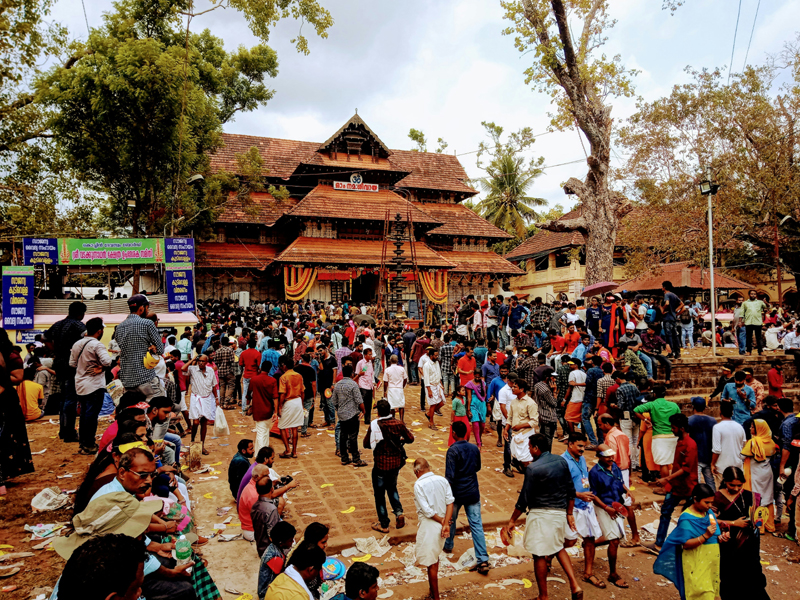
Why Vadakkunnadhan Is Kerala's Most Sacred Shiva Temple കേരളത്തിന്റെ ദക്ഷിണ കൈലാസം — വടക്കുന്നാഥൻ
Kerala has thousands of Shiva temples. But Vadakkunnadhan occupies a position among them that no other temple comes close to matching. The reasons are theological, historical, architectural, cultural and legendary — and all of them are inseparably intertwined.
The very name carries layers of meaning. Vadakkunnadhan — the Lord of the North — reflects the temple's geographic position on the northern side of Thrissur's central hillock, the Thekkinkadu Maidan. But devotees understand it differently: he is the Lord who came from the North, from his Himalayan home on Kailash, and chose this hillock in the heart of Kerala as his southern residence. Dakshina Kailasam — the Kailash of the South — is what this temple is called in the devotional tradition.
This temple is declared a National Monument of India. Its mural paintings — 17th-century masterpieces narrating the Mahabharata — are protected under the AMASR Act. The Archaeological Survey of India included it among 14 Kerala sites recommended for UNESCO World Heritage status in 2012. These are not decorations — they are recognitions of something that thousands of devotees have known for centuries: that what stands at the centre of Thrissur is irreplaceable.
The Sacred Legend — How Shiva Came to Thrissur ഐതിഹ്യം — ശിവൻ ഇവിടെ ഇറങ്ങിനിന്ന കഥ
The origin legend of Vadakkunnadhan Temple is told in the Brahmanda Purana and echoed in the oral traditions of every Brahmin household in Thrissur. It begins, as so many Kerala temple stories do, with Parashurama.
Parashurama — the sixth avatar of Vishnu, the axe-wielding warrior-sage — had committed a terrible sin: he had killed his own mother on his father's command, and in doing so had accumulated a karmic debt that weighed on him even as he performed penance. His father's gift — the ability to ask for any boon — allowed him to restore his mother's life. But the weight of what he had done drove him to create an act of immense cosmic merit.
He threw his axe from the Sahyadri mountains into the Arabian Sea. The ocean retreated before it. The land of Kerala rose from the waters — red, fertile and sacred. Parashurama stood on the edge of this newly created land and wept with wonder. He had made Kerala. But what would sanctify it?
He travelled to Mount Kailash and invited Shiva himself. Shiva, accompanied by Parvati, Ganesha, Subrahmanya and his divine entourage, descended from the Himalayas and walked southward with Parashurama. When they reached what is now Thrissur — specifically, a spot at the base of a great banyan tree on a hillock — Shiva stopped. He planted himself here. He manifested as a radiant lingam at the base of the banyan tree. This spot is known as the Sri Mula Sthana — the original sacred site.
Later, when a temple was to be built, the problem of the enormous banyan tree arose. Moving the lingam while the tree stood would be impossible — the roots had grown around and through the sacred spot. A tantric master named Yogatirippadu offered himself as a human shield: he wrapped himself around the lingam while the tree was felled, protecting the sacred stone with his own body. Remarkably — miraculously, the devotional tradition insists — not a single branch fell on the lingam. The tree was cleared. The lingam was moved with full ritual honours to its current location. The temple was built.
"He came from the North — from the snow and the silence and the highest peaks of the world — and he stopped here, on this small hillock in the middle of a town, and decided that this would do. That is the most Shiva thing about Vadakkunnadhan."
— Devotional understanding of the Sri Mula Sthana legend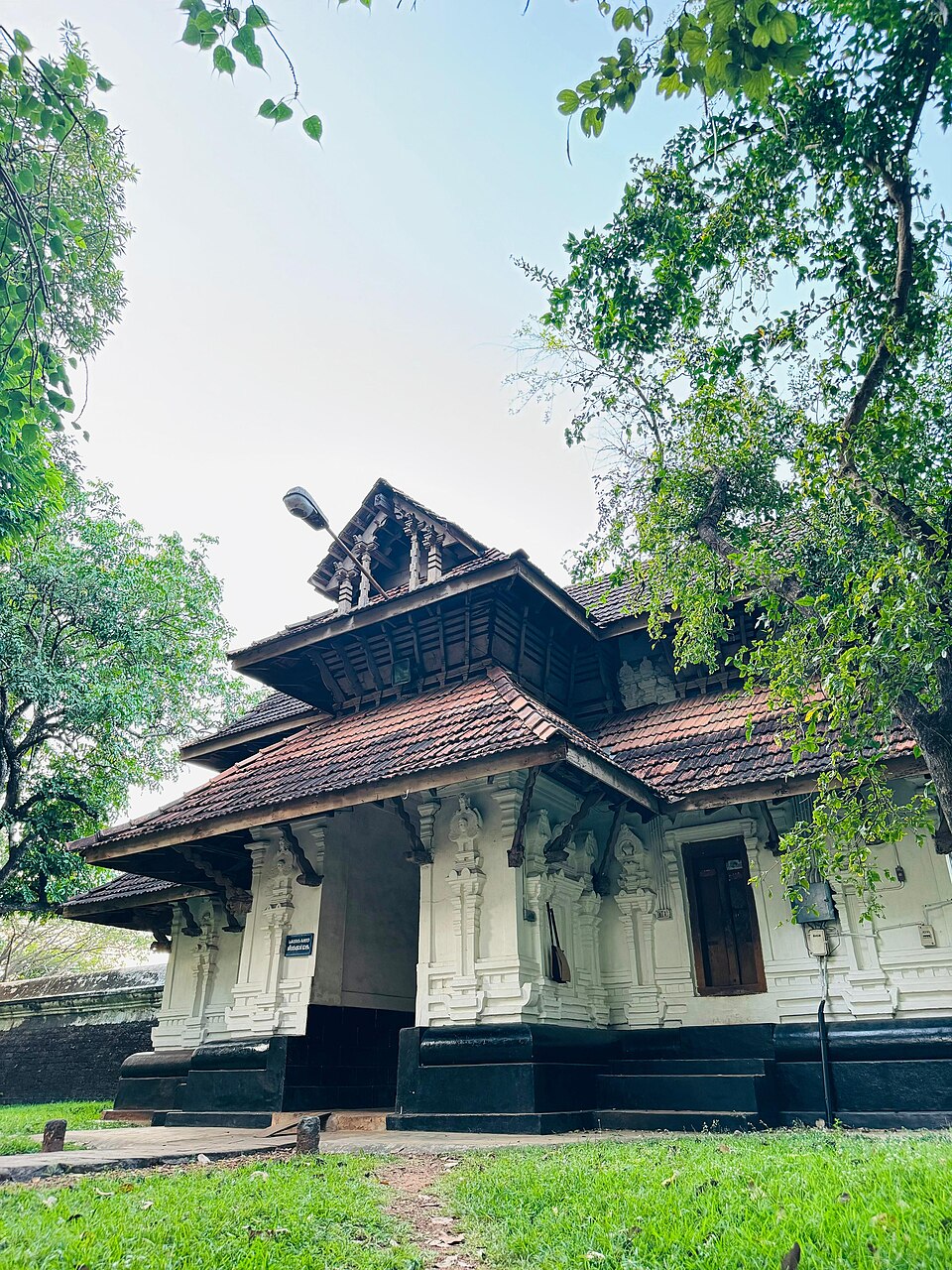
The Ghee Lingam — The Most Extraordinary Sacred Mystery in Kerala നെയ് ലിംഗം — ആ ഹിമവദ് ഗ്രഹം
When you approach the main sanctum of Vadakkunnadhan Temple and peer through the doorway of the Garbhagriha, you do not see what you see in any other Shiva temple in India. You do not see a smooth, polished lingam. You do not see stone at all.
You see a mountain.
Over centuries — perhaps more than a thousand years — of daily abhishekam performed with pure cow's ghee, the sacred offering has accumulated around and over the lingam. The ghee has hardened into a mound so large and so solid that it now stands 16 feet high and 25 feet wide. The lingam itself has not been seen for as long as any living tradition can remember — it lies somewhere within this great golden mountain of consecrated ghee, invisible and inaccessible, like the divine itself.
The mound is not formless. It has been shaped, consciously or by the alchemy of accumulated devotion, into something that resembles — unmistakably — a snow-covered mountain peak. Adorning its surface are thirteen cascading crescents of gold and three serpent hoods at the top — the cobra that traditionally shelters Shiva's lingam, here rising above the ghee summit like a crown.
What devotees and temple accounts find remarkable is that the ghee mound is said not to melt, even in summer. Kerala's summers are hot and humid, and ghee softens at roughly 32–35°C, so many visitors expect it to collapse. Yet temple tradition holds that the mound has stood for centuries and carries no foul odour despite its age. We have not found a published scientific study of this, so we present it as a widely repeated account — and as the devotee's own understanding — rather than as a laboratory finding.
For the devotee, the explanation is simple: this ghee is no longer an ordinary substance. It has been transformed, through the accumulated energy of millions of puja rituals, into something else — something that carries the concentrated devotional force of a thousand years of prayer. It represents Mount Kailash in miniature. When you stand before the Ghee Lingam, you are standing before Shiva's Himalayan home, recreated by faith in the middle of Kerala.
What We Can and Cannot Say
Some observers suggest that the sanctum's stone walls and the daily sealing of the ghee's surface with fresh layers may help preserve the mound, but we have found no published study confirming this. For many devotees the endurance of the mound is a matter of faith and wonder, and we leave it there.
Architecture and Temple Layout — A 1,300-Year-Old Masterpiece കേരള ശൈലി — 1300 വർഷം നിലനിൽക്കുന്ന ശില്പ ചാതുര്യം
The Vadakkunnadhan Temple is the definitive example of Kerala temple architecture at its most evolved. Built during the era of Perumthachan — the legendary master craftsman of Kerala's Parayi Petta Panthirukulam tradition — the temple is a textbook of spatial design, sacred geometry and structural excellence that has survived over thirteen centuries without major alteration.
The Four Gopurams
Unlike many large temples that have one or two gopurams (gateway towers), Vadakkunnadhan has one monumental gopuram on each of its four sides — north, south, east and west. Each gopuram marks a specific ritual entrance used for different ceremonial purposes. The stone walls enclosing the temple complex are immense — lofty, ancient and carrying the weathering of centuries in their surfaces. The enclosed area is so large that it functions as a park and public gathering space — the famous Thekkinkadu Maidan — for the city of Thrissur.
The Koothambalam — World's Oldest Living Theatre
Inside the temple compound stands a Koothambalam — a sacred theatre hall that is among the oldest in Kerala. Built at the time of Perumthachan (possibly 1,300 to 1,600 years old, depending on which historical account you follow), the Koothambalam was designed for the performance of Koodiyattam — the classical Sanskrit theatre tradition that UNESCO later declared an Intangible Cultural Heritage of Humanity.
The Koothambalam's interior is itself a masterpiece: its wooden pillars, carved brackets, sloped ceiling and acoustic design follow specifications so precise that the building functions as a near-perfect performance space even today. The wood carvings within the Koothambalam display vignettes from sacred narratives — frozen performances in wood, permanently installed in the walls of the performance hall.
The Sacred Shrines Within the Complex
| Shrine / Deity | Location in Complex | Special Significance |
|---|---|---|
| Paramashiva (Vadakkunnadhan) | Main sanctum — centre of complex | Ghee Lingam — Sri Mula Sthana Shiva, the presiding deity |
| Parvathy | Adjacent to main sanctum | Consort of Shiva — their joint presence makes the temple a complete Shaiva cosmological unit |
| Shankaranarayana | West-facing shrine | The combined form of Shiva and Vishnu — rare and theologically significant, representing the unity of the two greatest traditions |
| Rama | West-facing shrine | Venerated alongside Shankaranarayana — the temple's Vaishnava dimension |
| Ganapathi | East-facing — toward the kitchen | Remover of obstacles; faces east as is traditional for Ganesha |
| Gosala Krishna (Gopalakrishna) | Outer temple complex | Krishna as cowherd — a beloved, accessible form of the deity |
| Nandikeswara | Verandah of Nalambalam | Shiva's sacred bull — worshipped as a large white bullock; unique in scale and reverence |
| Parashurama | Outer shrine | The temple founder honoured with his own shrine within the complex he created |
| Ayyappa | Outer shrine | Shiva's son — particularly venerated in Kerala |
| Vettekkaran (Shiva as hunter) | Outer shrine | Connected to the Kiratarjuneeyam legend depicted in the murals |
| Simhodara | Outer shrine | A fierce form — rarely worshipped in temple settings outside Kerala |
| Adi Shankara | Commemorative shrine | The 8th-century philosopher Adi Shankaracharya, born in Kalady near Thrissur, is honoured here |
The Mahabharata Murals — 17th-Century Masterpieces on Temple Walls മഹാഭാരതം ഭിത്തിചിത്രങ്ങൾ — കേരളത്തിന്റെ ദൃശ്യ ഭാഗവതം
If the Ghee Lingam is Vadakkunnadhan Temple's most extraordinary ritual feature, its 17th-century mural paintings are its most extraordinary artistic achievement. These paintings — declared National Monuments alongside the temple itself — cover the inner walls of the complex with scenes from the Mahabharata that are among the finest examples of the Kerala mural tradition in existence.
What makes Kerala mural painting distinctive is its colour palette: five colours derived entirely from natural materials — white from ground limestone, black from lamp soot, yellow from orpiment (a mineral), green from dried leaves, and red from red lead or organic dyes. No synthetic pigments. No modern materials. And yet, seven centuries after many were painted, these colours retain a luminosity that seems to defy time.
The Kiratarjuneeyam — Shiva and Arjuna's Sacred Combat
Among the murals of Vadakkunnadhan, the Kiratarjuneeyam is the most celebrated. It depicts a pivotal episode from the Mahabharata: Arjuna, in the forest, performing severe penance to obtain the Pashupatastra weapon from Shiva. Shiva, testing Arjuna's worthiness, appears disguised as a hunter (Kirata) — accompanied by Parvati, also in disguise. A dispute over the carcass of a boar leads to combat between Arjuna and the disguised Shiva.
The mural captures the moment of this combat with extraordinary artistic sophistication. The expressions — Arjuna's fierce concentration, the hunter's amused power — are painted with a psychological depth rarely achieved in any religious art tradition. The colours around the hunter's eyes pulse with energy. This mural is also particularly resonant here because Vadakkunnadhan himself is the deity depicted — Shiva the hunter, wrestling with his devotee in the landscape of Kerala, is the same Shiva worshipped beneath the ghee mound in the sanctum behind the wall.
Nrithanatha and Vasukisayana — The Worshipped Murals
Two specific murals at Vadakkunnadhan are unique in Kerala: they are not merely decorative — they are themselves objects of active daily worship. Nrithanatha (Shiva as the Lord of Dance, depicted in the Nataraja pose) and Vasukisayana (Vishnu reclining on the cosmic serpent Adi Shesha) are treated as sacred presences, not artworks. Priests perform daily puja before them. Devotees offer prayers directly to the painted figures. This practice of worshipping a mural as a deity — not a representation of one, but the deity itself manifested in pigment and plaster — is extraordinarily rare in the world's religious traditions.
Thrissur Pooram — When the World Comes to Vadakkunnadhan ത്രിശ്ശൂർ പൂരം — ലോകത്തിലെ ഏറ്റവും മനോഹരമായ ഉത്സവം
There is a reason Thrissur is called the cultural capital of Kerala. Every year, for two extraordinary days in April or May, the entire city transforms into the stage for what is widely regarded as the most spectacular temple festival in the world.
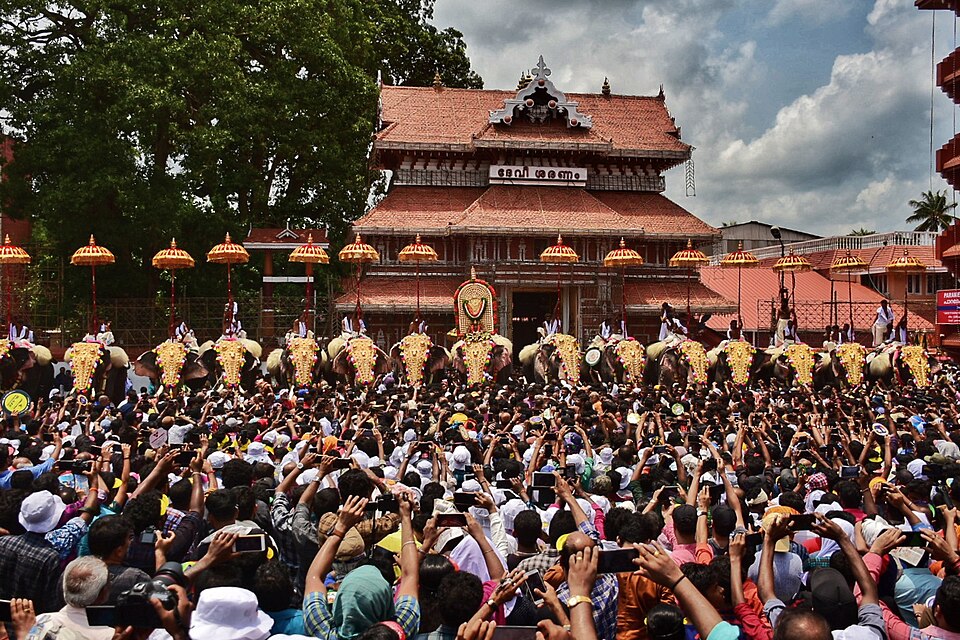
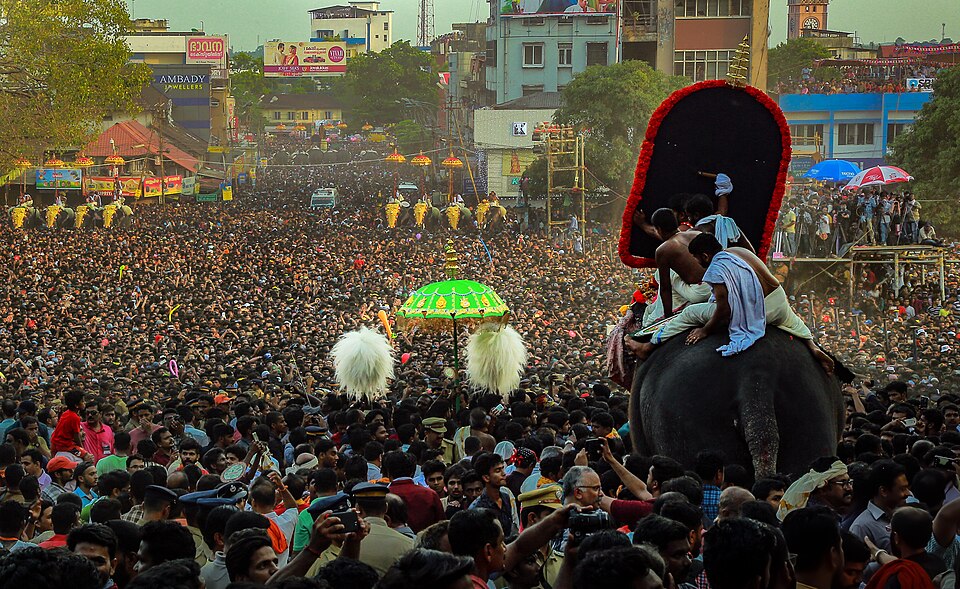
Thrissur Pooram takes place in Thekkinkadu Maidan — the open ground that surrounds the Vadakkunnadhan Temple on all sides. The festival belongs to the temple: it is conducted in honour of Lord Vadakkunnadhan, and the temple's gopurams form the sacred backdrop against which everything unfolds. And yet — uniquely — there are no special pujas inside the temple during Pooram itself. The festival's spiritual energy lives entirely in the open ground outside. This is extraordinary: a festival that honours a deity not by entering his home, but by filling every inch of the space around it with drumming, light and devotion.
The Origins — Sakthan Thampuran's Vision
Thrissur Pooram began in 1798, created by Raja Rama Varma — the Maharaja of Cochin, known to history as Sakthan Thampuran ("the prince of strong character"). Before Thrissur Pooram, the largest festival in Kerala was the Arattupuzha Pooram, held some distance away. When devotees from Thrissur were denied entry to the Arattupuzha Pooram for arriving late, they came to Sakthan Thampuran for resolution.
Sakthan Thampuran's response was characteristically large: instead of negotiating entry to another festival, he created one that would surpass it. He invited ten temples surrounding the Vadakkunnadhan Temple to bring their deities in procession to Thekkinkadu Maidan, uniting them in collective worship of the presiding deity. The ten temples — Paramekkavu, Thiruvambadi, Kanimangalam, Karamukku, Laloor, Chelakottukara, Panamukkampally, Ayyanthole, Chembukkavu and Neythilakavu — accepted. A new tradition was born. It has continued without interruption every year for over 225 years.
The Events of Thrissur Pooram — Hour by Hour
The Pooram unfolds across approximately two days of continuous ceremony. Here are the defining moments:
Kanimangalam Sasthavu Ezhunnellippu
ആദ്യ ദേവ എഴുന്നള്ളത്ത്
The first divine procession of Thrissur Pooram — the Sastha deity of Kanimangalam temple arrives at the Maidan before dawn, formally opening the festival ground and sanctifying the space for all that follows. Six more temple processions follow through the morning, each with their own musical ensemble and caparisoned elephants.
Madathil Varavu — The Great Musical Arrival
മഠത്തിൽ വരവ് — 200 കലാകാരന്മാർ
Madathil Varavu is a panchavadyam (five-instrument) melam performed with over 200 artists playing thimila, madhalam, trumpet, cymbal and edakka. The procession arrives at the temple with a sound architecture so elaborate and so powerful that it can be heard across Thrissur town. This is widely considered one of the greatest percussion performances in the world — not as a cultural spectacle, but as a living act of worship.
Ilanjithara Melam — Inside the Sacred Courtyard
ഇലഞ്ഞിത്തറ മേളം — ആരെയും വിസ്മയിപ്പിക്കും
The Ilanjithara Melam is Thrissur Pooram's most intimate musical event — and many who have heard it call it the most powerful. It takes place not in the open Maidan but inside the courtyard of the Vadakkunnadhan Temple itself, beneath the ilanjithara tree (Mimusops elengi). A percussion ensemble of drums, trumpets, pipes and cymbals performs here for approximately two hours. The sound, contained by the ancient stone walls of the temple courtyard, builds in intensity in a way that is physically overwhelming. Devotees describe the experience as not listening to music but being inside it.
Kudamattam — The Umbrella Exchange Ceremony
കുടമാറ്റം — ത്രിശ്ശൂർ പൂരത്തിന്റെ ആത്മാവ്
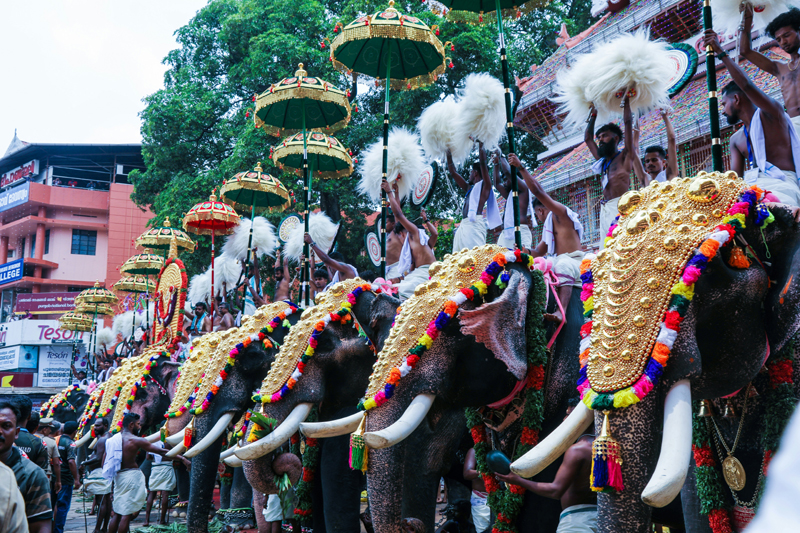
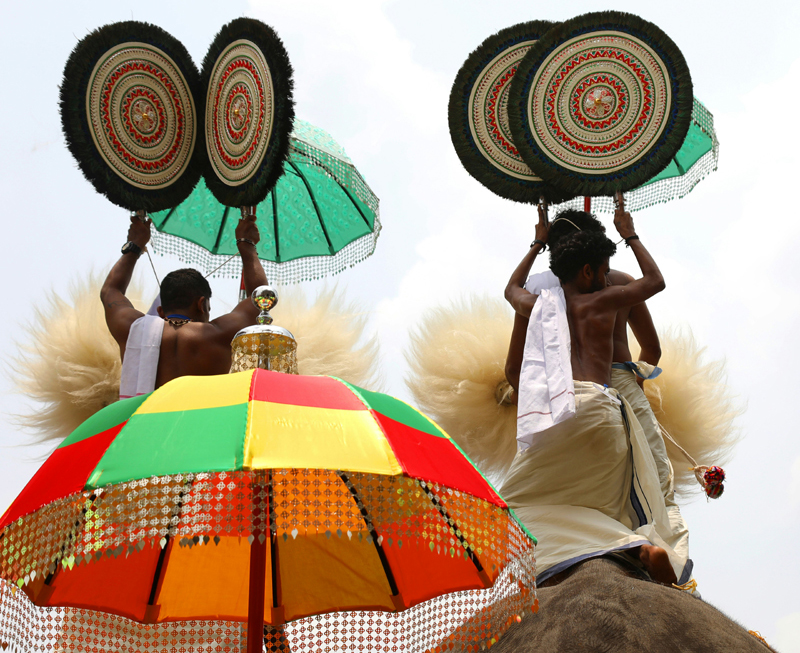
If Thrissur Pooram has one defining image — one moment that everyone who has ever attended remembers above all others — it is the Kudamattam. Two groups, Thiruvambadi and Paramekkavu, stand facing each other across the Maidan. Each group has fifteen caparisoned elephants bearing the temple deity's insignia. To the thundering accompaniment of Panchari Melam percussion, the two groups engage in a rhythmic, competitive exchange of ornamental silk parasols. Each round, a different colour, a different design — each set made fresh for this single ceremony. The drama builds with every exchange; the crowd surges; the drums intensify. And then it shifts again — a new umbrella set, a new colour, a new burst of percussive intensity. Kudamattam can last for hours.
Vedikkettu — The Grand Finale in Fire and Light
വെടിക്കെട്ട് — ആകാശം ജ്വലിക്കുന്നത്
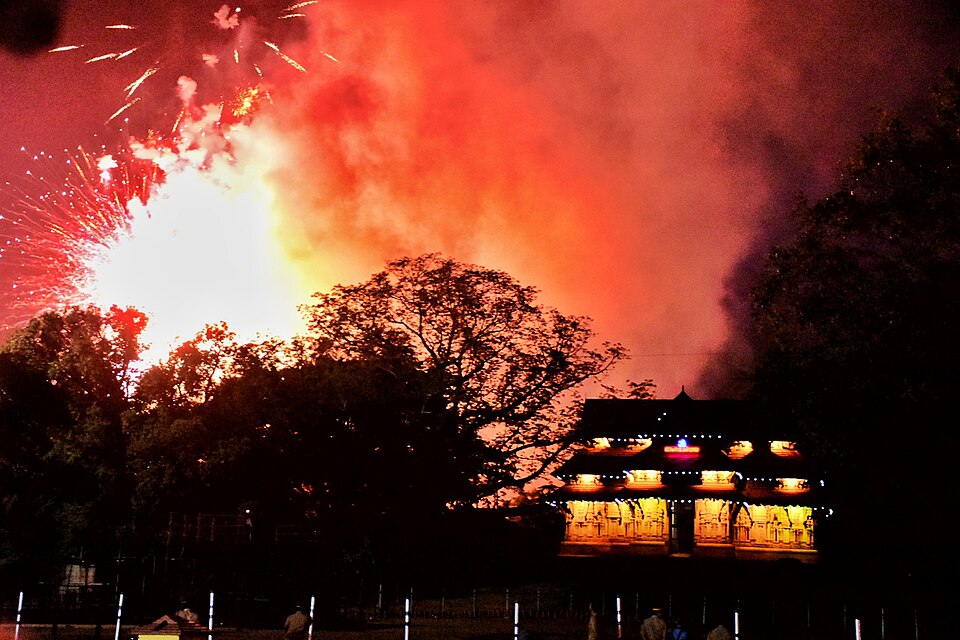
The Vedikkettu — the fireworks display — brings Thrissur Pooram to its crescendo in the early hours of the morning. Two teams, Thiruvambadi and Paramekkavu, compete in what is essentially the world's most elaborate competitive fireworks performance. Each burst is answered by the other, building in complexity and spectacle, until the sky above Thekkinkadu Maidan is continuous colour and thunder. The display can last up to three hours. People travel from across India — and increasingly from across the world — specifically to witness it.
Thrissur Pooram 2026 — Planning Your Visit
Thrissur Pooram 2026 falls on Pooram Nakshatra in the Malayalam month of Medam — typically late April or early May. Confirm the exact date from the official Thrissur Pooram committee website. Book accommodation 6–8 months in advance — hotels within 25 km fill completely. For Kudamattam viewing, position yourself in the Thekkinkadu Maidan by 3:00 PM at the latest. For Vedikkettu, find your spot by 11:00 PM for the best view. Public transport is the only viable option on Pooram day — parking near the temple is impossible from before sunrise.
Other Sacred Celebrations at Vadakkunnadhan ഇതര ഉത്സവങ്ങൾ — ശിവരാത്രി, ആനയൂട്ട്
While Thrissur Pooram overwhelms every other event in the temple's calendar, Vadakkunnadhan is a living, active temple year-round — not merely a festival venue.
- Maha Shivaratri: The Great Night of Shiva — observed with all-night fasting, vigil and continuous puja inside the temple. Devotees who believe that staying awake through this night in prayer to Shiva receive liberation from the cycle of rebirth come from across Kerala. Inside the temple on this night, the energy is almost physically tangible.
- Anayoottu (Elephant Feeding): The ritual feeding of temple elephants — one of the most culturally distinctive rituals in Kerala's temple tradition. Elephants are considered living vehicles of the divine, and feeding them is an act of direct devotion. At Vadakkunnadhan, the Anayoottu draws devotees who come specifically to participate in or witness this feeding.
- Navarathri: The nine-night festival of the goddess — celebrated across the complex with special pujas at the Parvathy shrine. The convergence of Shaiva and Shakta energies here during Navarathri makes this a particularly charged period.
- Ashtami Rohini: The birth anniversary of Krishna — celebrated at the Gosala Krishna shrine within the complex with special abhishekam and decoration.
- Karthika: The festival of lights in the Malayalam month of Karthika — when lamps are lit across the temple complex and Shiva's presence is celebrated in the form of eternal light.
Darshan Timings and Puja Schedule ദർശന സമയം — ഓരോ പൂജയും
🕐 Vadakkunnadhan Temple — Daily Puja and Darshan Schedule
| Puja / Event | Time (approx.) | What It Means |
|---|---|---|
| Temple Opens / Nirmalyam | 4:00 AM | The accumulated nighttime puja energy is cleared — the most spiritually charged moment of the day. The temple is at its most peaceful and most deeply charged at this hour. |
| Abhishekam with Ghee | ~5:00 AM | The daily addition to the Ghee Lingam — ghee is poured over the sacred mound, continuing a tradition that has continued without interruption for centuries. |
| Usha Puja (Dawn Puja) | 6:30 AM | The first full morning puja — flowers, incense, lamp and food offerings as the temple enters its active devotional day. |
| Pantheeradi Puja | 8:30 AM | The mid-morning puja — the deity appears in full morning regalia with elaborate flower decoration. |
| Uchabali (Noon Puja) | ~11:00 AM | The midday offering — the final puja of the morning session before the afternoon break. |
| Temple Closes | 11:00 AM | Afternoon break until 4:30 PM. |
| Evening Opens | 4:30 PM | Evening darshan begins — the light inside the sanctum at this hour, combined with the golden glow of the ghee mound, is extraordinarily beautiful. |
| Deeparadhana | ~7:00 PM | The lamp-waving ceremony — one of the most visually powerful rituals at any Kerala temple. Before the Ghee Lingam, the effect is indescribable. |
| Temple Closes | 8:20 PM | Final prayers and closure. |
How to Reach Vadakkunnadhan Temple, Thrissur വടക്കുന്നാഥൻ ക്ഷേത്രത്തിൽ എത്തിച്ചേരാൻ
The temple is located at the very centre of Thrissur town — Round East, Thekkinkadu Maidan, Thrissur 680001. It is impossible to miss; every road in Thrissur orients itself toward Thekkinkadu Maidan.
By Train
Thrissur Railway Station is 2 km from the temple — the closest major station. Thrissur is on the main Shoranur–Ernakulam rail line and has excellent connectivity to all major Kerala cities. Auto-rickshaws from the station to the temple take approximately 10 minutes.
By Air
Cochin International Airport (COK) is approximately 62 km away (about 1.5 hours by road). Calicut International Airport (CCJ) is approximately 100 km away. Taxis are readily available from both airports to Thrissur.
By Road
- From Kochi: 75 km via NH 544. Journey: approximately 1.5 hours.
- From Kozhikode: 130 km via NH 66. Journey: approximately 2.5 hours.
- From Palakkad: 55 km. Journey: approximately 1 hour.
- From Guruvayur: 29 km via NH 544. Frequent KSRTC and private buses.
- During Pooram: Do not drive to the temple — park at the town outskirts and use auto-rickshaws or walk. The radius of several kilometres around Thekkinkadu Maidan is effectively impassable by vehicle from the morning of Pooram day.
📌 Practical Tip
Pair your visit to Vadakkunnadhan with a visit to the Thrissur Zoo and Sakthan Thampuran Palace Museum (both within 2 km) and the nearby Punnathur Kotta Elephant Sanctuary at Guruvayur (29 km) for a complete Thrissur cultural circuit.
Frequently Asked Questions — Vadakkunnadhan Temple പ്രധാന ചോദ്യങ്ങൾ
📖 Explore more deep articles on Kerala's sacred temples.
Back to All Blogs →