Ritual 01Divine Possession
Theyyam — When a Human Being Becomes a God
തെയ്യം — മനുഷ്യൻ ദൈവമാകുമ്പോൾ
There is no other ritual tradition in the world quite like Theyyam. Not because no other culture attempts divine possession — many do — but because Theyyam does it with a completeness, a specificity and a visual intensity that leaves even experienced scholars of comparative religion speechless.
Theyyam is a living tradition of northern Kerala (primarily Kannur and Kasargod districts) in which a ritual performer undergoes a preparation process lasting many hours before a specific deity descends into their body. The preparation begins with elaborate makeup — ground natural pigments applied in layers, building up specific features of the deity's face. Then comes the costume, which can take 4–8 hours to assemble: towering crown (mudi) of woven palm fronds, curved wooden frames bearing the deity's insignia, layers of sacred cloth, hundreds of specific ornaments.
But the most important preparation is internal. The performer fasts for days before the ritual. They undergo purification rites. They observe specific behaviours — abstaining from certain foods, sleeping apart from family, reciting the deity's origin stories (tottam pattu) in preparation. By the time the physical transformation is complete, a psychological and spiritual transformation has also occurred. The performer is no longer simply wearing a costume. They have undergone a process designed to hollow out the ego and create a vessel for the divine.
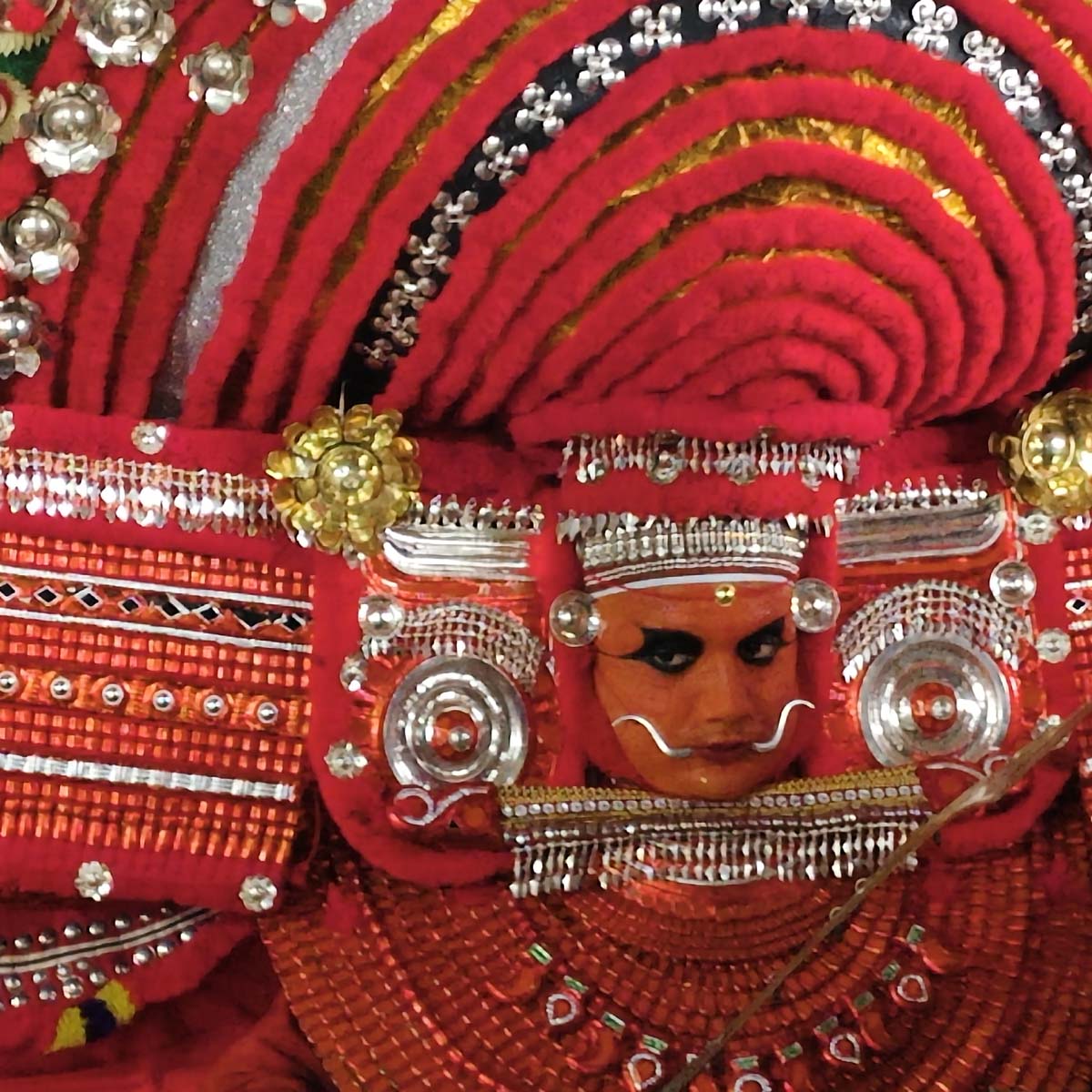
The 456 Forms of Theyyam
There are 456 identified forms of Theyyam, each representing a different deity, ancestor, hero or deified historical figure. Muthappan Theyyam — the hunter-god who accepts toddy and fish — is perhaps the most beloved. Pottan Theyyam challenges caste hierarchy through the story of a philosophical debate between a low-caste man and Adi Shankaracharya. Chamundi Theyyam represents the fierce goddess who destroyed the demon Darika. Each form has its own makeup patterns, its own costume specifications, its own tottam pattu origin songs, and its own ritual structure.
Why Theyyam Is Theologically Revolutionary
Most Hindu traditions maintain a strict boundary between priest, deity and devotee. The priest mediates. The deity is present in the idol. The devotee approaches with respect and distance. Theyyam demolishes this structure entirely.
Theyyam is historically performed by communities outside the Brahmin priesthood — Vannan, Malayan, Mavilan, Kopalan, Velan and other communities whose members are the designated hereditary performers of specific Theyyam forms. When a Theyyam performer from one of these communities enters the ritual space and the deity descends into them, they become, for the duration of the performance, higher in spiritual status than any Brahmin priest. The entire community — including high-caste devotees — touches their feet, receives blessings from their hands, hears the deity's words through their mouth.
Theyyam is, in theological terms, a profound statement about the nature of the divine: grace does not flow along caste lines. It flows through whoever is prepared to receive it.
Where and When to Witness Theyyam
Theyyam season runs from November through May. The main districts are Kannur and Kasargod. Key venues include the Parassinikadavu Muthappan Temple (near Kannur) where Muthappan Theyyam occurs daily — uniquely, this is the only Theyyam that takes place every single day of the year. For authentic village Theyyam performances, contact the Kannur District Tourism Promotion Council for the seasonal calendar.
🛍 Kerala Culture — Available on Amazon
Affiliate Links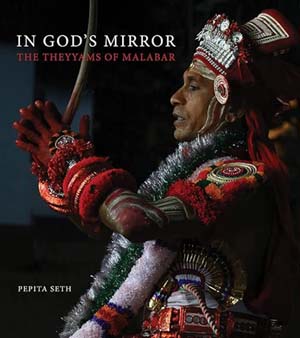
Theyyam — Books & Art
Explore Theyyam's 456 forms through illustrated books, documentary art and cultural publications.
Shop on Amazon →
Kerala Kasavu Saree
Authentic Kerala set-mundu and kasavu sarees — the traditional attire for temple visits and festivals.
Shop on Amazon →
Ritual 02Oracle Tradition
Velichappadu — The Oracle Who Bleeds for the Goddess
വെളിച്ചപ്പാട് — ദേവിയുടെ ശബ്ദം
In many Kerala temples dedicated to Bhagavathy (the goddess), there is a figure you will not find described in any textbook of standard Hindu practice. He stands apart from the main ritual. He wears red — a bright, often blood-red dhoti. He carries a sword. And at a specific moment in the puja sequence, something happens to him that transforms the atmosphere of the entire temple.
The Velichappadu (also called Komaram) enters a state of possession by the deity. His body trembles. His eyes change. His posture shifts from that of a man to something else. He begins to move differently — sometimes spinning, sometimes advancing toward the crowd with an energy that makes devotees involuntarily step back. And then he takes the sword and strikes himself — not deeply, but deliberately — on the forehead.
The blood that appears is understood by the tradition as confirmation of authentic divine presence. The Velichappadu is not hurting himself. The goddess is marking her messenger. And now, in this state, he speaks — addressing specific devotees, answering prayers that were offered inwardly but never spoken aloud, delivering oracles about the community's future and the resolution of individual crises.
The Theological Function of the Velichappadu
Velichappadu literally means "revealed light" or "light that comes forth." The name points to the core understanding: the Velichappadu is a medium through whom the goddess makes herself visible to her community. He is not a priest — priests mediate through ritual protocols. He is not a philosopher — he does not interpret the divine through texts. He is a direct conduit. When the goddess possesses him, the boundary between heaven and earth, between divine intention and human understanding, temporarily dissolves.
The tradition is ancient and community-specific. Certain families have been Velichappadu practitioners for generations — the role is hereditary and carries enormous spiritual responsibility. A Velichappadu who performs incorrectly or without genuine preparation is understood to risk severe consequences. The tradition self-regulates through the weight of its own responsibility.
"When the Velichappadu strikes the forehead, the blood is not pain. It is the goddess saying — I am here. I am real. This is not theatre. Listen."
— Devotional understanding of the Velichappadu tradition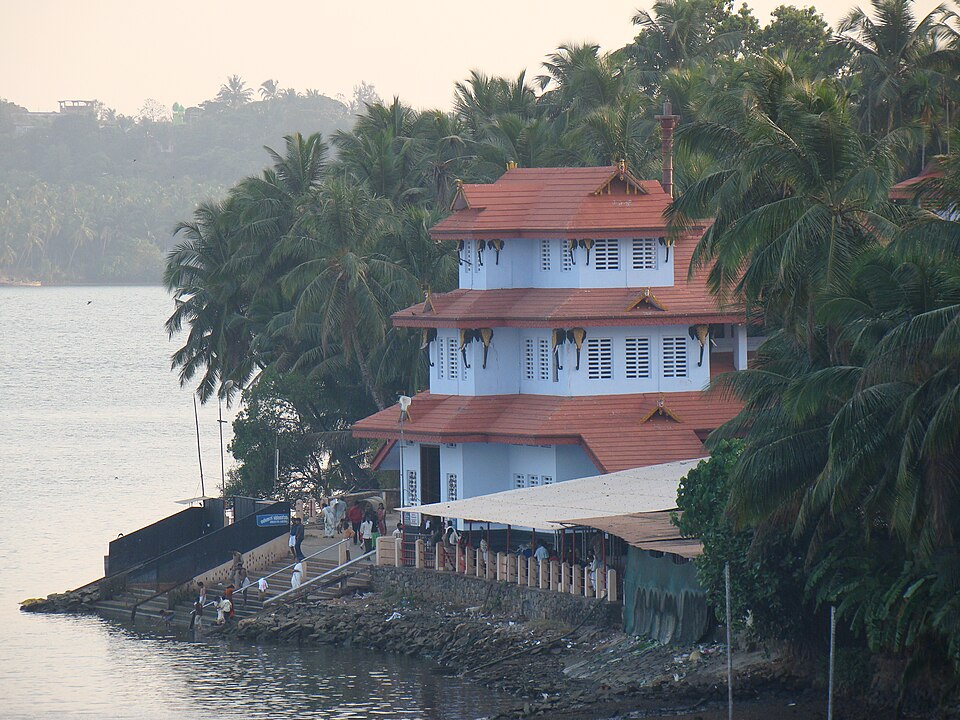
Ritual 03Hook-Swinging · Bhagavathy Temples
Garudan Thookkam — Flying for the Goddess
ഗരുഡൻ തൂക്കം — ഭക്തി ആകാശത്തിൽ
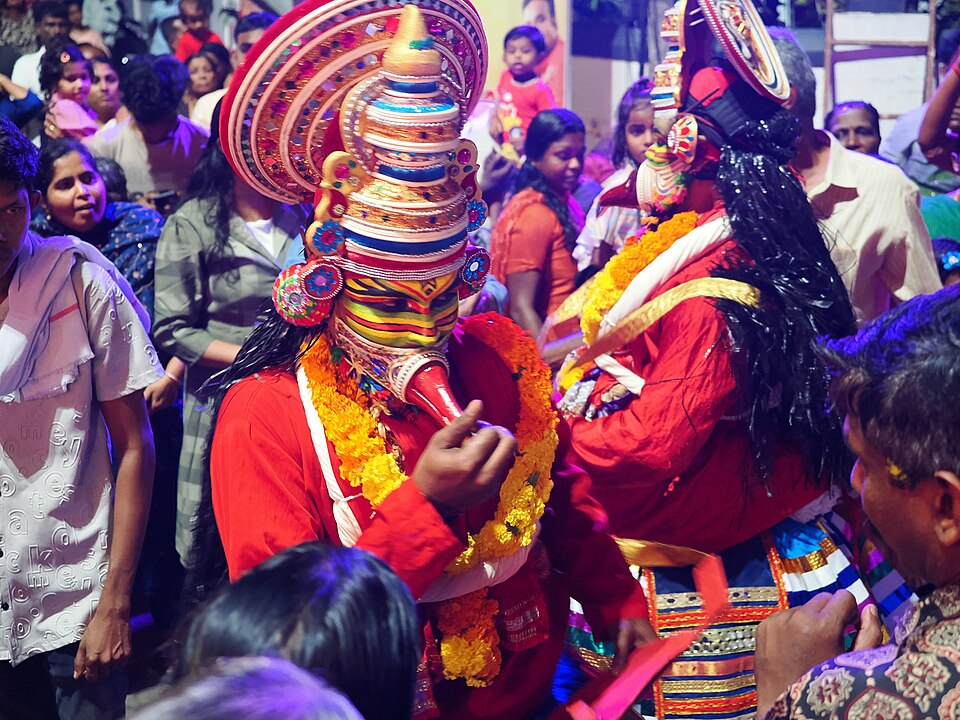
In the courtyards of certain Kerala Bhagavathy temples during festival season, you may see something that stops every first-time visitor cold. A man — dressed in the elaborate headdress and body paint of Garuda, the divine eagle of Vishnu — is being prepared for something extraordinary. Priests have pierced large metal hooks through the skin of his back. He has been fasting and meditating for days. And now, he is hoisted by those hooks — the entire weight of his body suspended from them — and the rotating frame on which he hangs begins to turn, carrying him in slow, majestic circles above the crowd below.
This is Garudan Thookkam — Garuda's swing, or more literally, Garuda's suspension. It is one of the most visually arresting ritual performances in all of India, and one of the most misunderstood.
Who Performs Garudan Thookkam and Why
Garudan Thookkam is always a vow fulfillment ritual (nercha). A devotee — or a family on behalf of a devotee — makes a solemn promise to the goddess during a crisis: a serious illness, a dangerous surgery, a life-threatening situation. The vow is: if you heal me, if you bring me through this, I will offer my body to you as Garuda offers himself to Vishnu. I will fly for you.
When the crisis resolves, the vow must be honoured. The devotee who performs the Thookkam prepares for months — purifying diet, specific meditation, physical conditioning. On the festival day, the hooks are pierced through the skin of the back by the temple priest. This piercing is itself a ritual act, performed with full puja protocol. Participants commonly describe feeling little pain during the piercing, which devotees attribute to months of preparation and the grace of the goddess. We have not found published medical studies that explain this experience.
During the suspension, the performer embodies Garuda — the cosmic eagle, the vehicle of Vishnu, who is also understood as the natural enemy of the serpents that the goddess destroys. The Thookkam is therefore not simply a physical feat of endurance. It is a living narrative: Garuda comes to the temple, circles the goddess, acknowledges her power, and departs. It is cosmology enacted through a human body hanging from hooks in the sky.
What Is Known — and What Is Not
Reports of little pain during Garudan Thookkam have drawn curiosity, but we have not found solid medical studies of the Kerala practice, so we cannot offer a scientific explanation. Researchers elsewhere have studied piercing and suspension rituals, and sometimes suggest that intense preparation, focused attention and adrenaline can change how pain is felt; these are general ideas, not findings about this ritual. What is certain is that piercing the skin carries real risks of injury and infection.
This is a sacred vow performed by prepared participants with priestly guidance. It is not routine or safe for anyone else to attempt, and we do not encourage it.
Ritual 04Devotional Vow · Murugan Temples
Kavadi Attam — Carrying the Burden of Devotion
കാവടി ആട്ടം — ഭക്തിയുടെ ഭാരം
The mythology behind Kavadi begins with Shiva's two sons, Ganesha and Murugan, competing to circumambulate the universe. Ganesha simply walked around his parents — Shiva and Parvati — declaring that they contained the entire universe. Murugan, the warrior-son, set off on his peacock to circle the cosmos properly. When he returned to find he had lost the competition, he withdrew to a mountain in South India in contemplative semi-retirement.
Meanwhile, a devoted sage named Agastya was asked by Shiva to carry two hills from the Himalayas to the south of India. Agastya entrusted this task to his disciple Idumban, who used a kavadi — a shoulder pole with the hills suspended from each end — to carry them south. When he rested near Murugan's mountain and tried to resume his journey, he found the hills immovable. Murugan had seated himself on one of them. After a battle and reconciliation, Idumban was blessed by Murugan and his kavadi was declared a sacred offering.
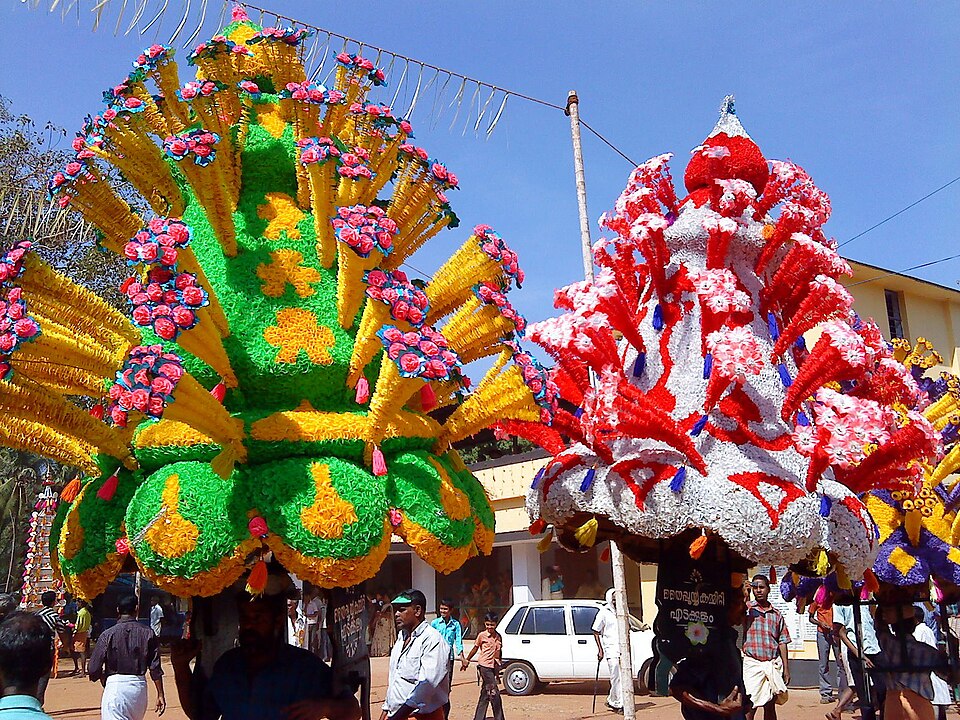
This myth is the origin of Kavadi Attam — the ritual carrying of a decorated arch or structure (the kavadi) as an offering to Murugan. In its simplest form, the kavadi is a wooden or metal arch decorated with flowers, peacock feathers and images of Murugan, balanced on the shoulders and carried in a dance of devotion to the temple.
Piercing Kavadi — Vel Kavadi
The more extreme form — Vel Kavadi — incorporates body piercing as part of the offering. The vel (sacred spear of Murugan) is represented by actual thin spears or needles pierced through the cheeks, tongue, forehead, torso and other areas. The devotee who undertakes Vel Kavadi has prepared through weeks of fasting, celibacy and prayer. The piercing is performed by experienced ritual practitioners under specific conditions.
The tradition holds that a genuinely prepared devotee — one whose motivation is pure, whose preparation is complete, and whose mind is fully surrendered to Murugan — experiences the piercing without pain and bleeds minimally or not at all. Many practitioners describe this experience. We have not found medical studies we can confidently cite for Kerala's Vel Kavadi, and piercing carries real risks of injury and infection.
Kerala's most significant Kavadi observances take place at Murugan temples during Thaipusam (January–February) and Skanda Shashti (October–November). Check the temple's own announcements for dates.
Ritual 05Theekkali · Bhagavathy Temples
Fire-Walking — Walking Through the Goddess's Breath
തീ മിതി — ദേവിയുടെ ദൈവ സംരക്ഷണ ദർശനം
Fire has always been central to Hindu ritual — it is Agni, the sacred fire-god, who carries offerings to the other deities. But in certain Bhagavathy temples of Kerala, fire is not merely a symbol or a medium. It is a test. And devotees walk through it.
Theekkali or Thee Mithi (fire-walking) is performed in the temple compound where a long trench of burning coals — typically 15 to 30 feet long, heated to temperatures between 500°C and 800°C — is prepared by temple authorities. Devotees who have made a vow to the goddess walk barefoot across this burning bed as the fulfilment of that promise.
The preparation is extensive and treated with absolute seriousness. Devotees undertake a period of ritual purity — typically 14 to 41 days of fasting, celibacy, daily purification rituals and continuous prayer. On the day of the fire-walking, additional purification rites are performed at the temple. The walk itself is preceded by a priest's blessing and begins only after the devotee's mental focus is confirmed through observation of their demeanour.
The Experience of Fire-Walking
Most experienced fire-walkers describe an unusual quality of the experience: a sense of coolness, rather than burning. The coal bed, they report, feels beneath their feet not like fire but like the earth — warm, present, unyielding but not dangerous. This is understood theologically as the goddess's protection manifesting as a physical reality. In the devotee's understanding, the fire is transformed by genuine devotion.
Physics offers explanations that account for many cases in which no burn occurs — chiefly the short contact time and the low thermal conductivity of wood embers and ash. These explanations do not make fire-walking safe, and burns do occur. For devotees, the sensation of coolness is understood as the goddess's protection; we make no scientific claim about it.
Fire-walking is performed at certain Bhagavathy, Kali and Durga temples across Kerala, and continues to draw both devotees and scholars who find that neither purely religious nor purely physical explanations fully capture what happens.
Ritual 06Sacred Transgression · Kodungallur
Kodungallur Bharani — Where the Rules Dissolve Before the Goddess
കൊടുങ്ങല്ലൂർ ഭരണി — ദേവിക്ക് മുന്നിൽ സകല ചട്ടങ്ങളും ഉരുകുന്നു
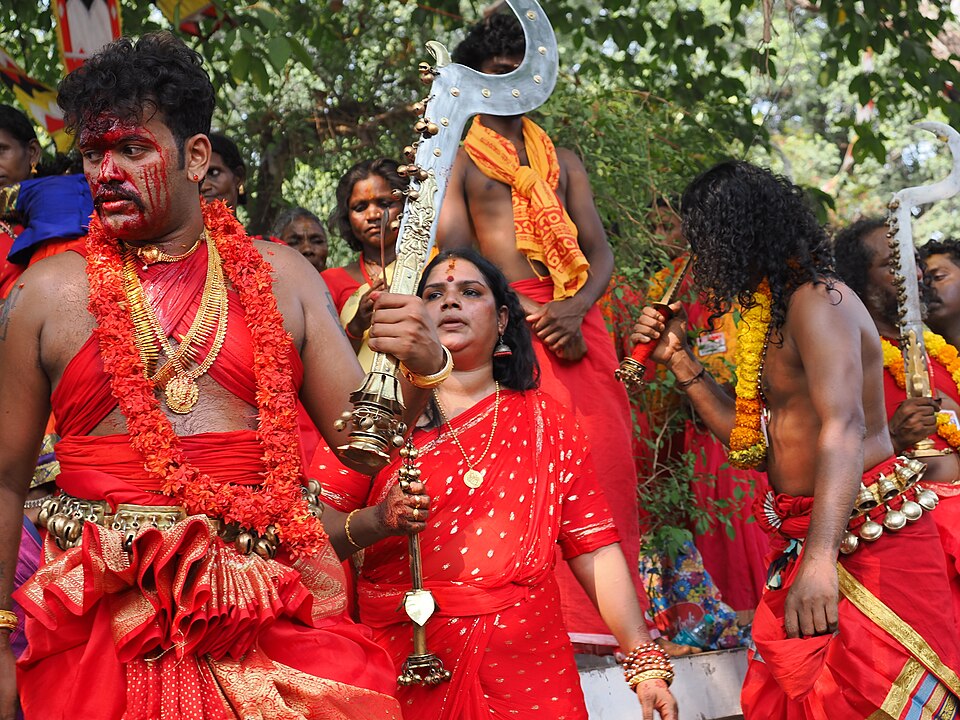
Once a year, at the Kodungallur Bhagavathy Temple in Thrissur district, something happens that challenges every conventional understanding of how a Hindu temple festival should proceed. The Kodungallur Bharani — held during the Malayalam month of Meenam — is one of the most theologically complex and anthropologically significant sacred events in all of India.
The Bharani begins with the arrival of devotees from across Kerala — many of them walking barefoot for days, carrying ritual weapons, their faces and clothes marked with red representing the goddess's fierce energy. As the festival intensifies, the social codes that govern ordinary life are deliberately and systematically transgressed. Songs are sung that would be unspeakable anywhere else — crude, raw, explicit, directed at the goddess herself. In the festival's theology, this transgression is not sacrilege. It is the most profound form of intimacy.
The theoretical foundation is this: Kodungallur's goddess, Kurumba Bhagavathy, is understood as a force of such totality that she encompasses everything — including the aspects of existence that polite society excludes. To sing the unspeakable before her is to acknowledge that she is larger than any human convention, that nothing within the cosmos is foreign to her, that the devotee who comes to her can come without pretence. It is complete nakedness before the divine.
The Bharani also involves a ritual called Kavu Theendal — the touching of the sacred grove — in which devotees run through the temple's restricted sacred grove striking the trees with small sticks, a rite that normally would be strictly prohibited. The ritual meaning: even the tree is touched by the goddess's energy on this day; even the boundary between sacred and profane temporarily dissolves.
Ritual 07Ritual Art · South Kerala
Padayani — Kolam Thira and the Return of the Goddess
പടയണി — ദേവി മടങ്ങി വരുന്ന ആഘോഷം
Padayani (literally "the march of the army") is a ritual art form primarily found in Pathanamthitta district in south Kerala — a combination of sacred dance, giant mask-art, drumming and fire that celebrates the return of Bhagavathy from her cosmic battle. The origin myth describes how the goddess Bhagavathy, having defeated the demon Darika, returned in a state of extreme agitation — blood-drunk, fierce, vibrating with post-battle energy that was dangerous to the cosmos.
To calm her and celebrate her victory, the community created an elaborate welcoming performance. They made giant kolam thirakku — huge masks of various deities and cosmic entities painted on dried palm leaves — and performed dances with these masks, accompanied by thundering percussion. The masks represent the full spectrum of cosmic forces: Pakkanar, Kalan (the lord of death), Yakshi (the forest spirit), Bhairavi (the fierce form), Kuthira (the horse of Kalan), Maruta (the wind). The Padayani is the community's gift to the returning goddess — their way of saying: we have held a feast for you, we have danced for you, we have welcomed your victory with all the energy we have.
Padayani performances last from dusk to dawn and are conducted at specific temples on specific festival days. The performance space itself — the open courtyard illuminated by large oil lamps, the percussion filling the night air, the massive kolam masks moving in the lamplight — is one of the most atmospherically powerful ritual experiences Kerala offers.
Ritual 08Serpent Worship · Sarpakavu
Sarpa Bali and Sarpakavu — The Sacred Ecology of Serpent Worship
സർപ്പബലി — സർപ്പ കാവ്, ഭൂമിയുടെ ദൈവ സംരക്ഷകർ
In Kerala's sacred landscape, serpents are not feared or merely respected — they are worshipped as divine guardians of the earth, the water, the lineage and the home. The Sarpakavu (serpent grove) attached to countless Kerala homes and temples is one of the world's oldest and most effective biodiversity conservation systems — a patch of untouched forest maintained for thousands of years simply because the serpent deity lives there and must not be disturbed.
Sarpa Bali is the elaborate ritual propitiation of the serpent deities — a ceremony that can last several days, involves the creation of intricate kolam (sacred drawings) depicting the full hierarchy of serpent deities, and culminates in a ritual feeding, prayer and cleansing of the Sarpakavu. Families perform Sarpa Bali to address specific misfortunes understood as resulting from harm to serpents — the cutting of a Sarpakavu tree, the accidental killing of a snake, or ancestral transgressions against serpent-worship protocols.
The most famous serpent temple in Kerala is Mannarsala Nagaraja Temple in Alappuzha district — a massive Sarpakavu stretching over many acres, where thousands of stone serpent images have been installed over centuries by families seeking blessings. The presiding deity is a Brahmin woman priest (the Mannarsala Amma) — itself an extraordinary tradition in a land where temple priesthood is almost universally male.
Where and When to Witness These Rituals ഈ ആചാരങ്ങൾ എവിടെ, എപ്പോൾ കാണാം
| Ritual | Best Locations | Season / Timing | Notes |
|---|---|---|---|
| Theyyam | Kannur & Kasargod districts; Parassinikadavu Muthappan Temple (daily) | November to May (Theyyam season) | Parassinikadavu is the only Theyyam daily year-round. Village Theyyams are most authentic — ask local tourism offices. |
| Velichappadu | Bhagavathy temples across Kerala, especially Kodungallur | During temple festivals | Most Bhagavathy temples have Velichappadu during annual festivals — check the temple calendar. |
| Garudan Thookkam | Thrissur district Bhagavathy temples | Medam–Edavam (April–June) | Associated with the Thrissur Pooram season. Specific temples in and around Thrissur. |
| Kavadi Attam | Murugan temples across Kerala | Thaipusam (Jan–Feb), Skanda Shashti (Oct–Nov) | Flower Kavadi is widely seen. Vel Kavadi (with piercing) at specific temples. |
| Fire-Walking | Bhagavathy and Kali temples across Kerala | During major Bhagavathy festivals (Meenam and Medam) | Confirm with specific temples — not all fire-walking is publicly viewable. |
| Kodungallur Bharani | Kodungallur Bhagavathy Temple, Thrissur district | Meenam Bharani (March–April) | One of Kerala's most extraordinary festivals. Open to all. Arrive the evening before. |
| Padayani | Pathanamthitta district — Thiruvalla, Kottayam area temples | Karkidakam–Vrischikam (Oct–Nov) | All-night festival — arrive at dusk, stay through dawn. |
| Sarpa Bali / Sarpakavu | Mannarsala Nagaraja Temple, Alappuzha; family Sarpakavus statewide | Year-round at Mannarsala | Mannarsala's massive Sarpakavu is open to visitors. |
Why These Rituals Are Not "Unusual" — They Are Kerala's Sacred Grammar ഈ ആചാരങ്ങൾ അസ്വഭാവികമല്ല — ഇവ കേരളത്തിന്റെ ദൈവഭാഷ
From the outside, rituals like Garudan Thookkam or Velichappadu can appear alarming — even violent. The instinct of the Western observer (and sometimes the urbanised Indian observer) is to ask: is this safe? Is this rational? Is this really religious, or is it something else?
These are understandable questions. But they proceed from a framework of what religion "should" look like — quiet, interior, philosophical, text-based — that does not apply to the living traditions of Kerala's temples. These traditions belong to a different theological vocabulary, one in which the body is not separate from the spirit but is its most direct instrument; in which the divine is not approached through abstraction but met face to face; in which the community's relationship with its gods is intimate, reciprocal and conducted through the full range of human experience.
When a Theyyam performer becomes a deity, the divine has crossed over into the human. When a Velichappadu strikes his forehead, the goddess has moved close enough to bleed through her messenger. When a devotee walks through fire for the goddess, they are enacting a belief found in many traditions: that complete surrender to the divine can change what a person is able to endure.
These are not superstitions to be waved away. They are living expressions of a theological vocabulary in which the body is a direct instrument of devotion — and they deserve to be understood on their own terms, with respect for the participants and a clear awareness of the physical risks involved.
Frequently Asked Questions — Kerala's Extraordinary Temple Rituals സ്ഥിരം ചോദ്യങ്ങൾ
📖 Explore more deep articles on Kerala's sacred traditions.
Back to All Blogs →